Deep-DiveOct 8, 2026•4 min read
Can AI Become the Ultimate Scientist?

Lukas WeberDeep-Space Correspondent
Deep-DiveOct 8, 2026•4 min read
Can AI Become the Ultimate Scientist?
Lukas WeberDeep-Space Correspondent
“
Can computers do science experiments? Let's discover how super-fast AI robots help human scientists solve the world's biggest mysteries!
Imagine you are playing a game where you have to find a tiny red LEGO brick hidden inside a giant swimming pool filled with billions of blue bricks. If you tried to find it by yourself, it would take you many, many days, right?
But what if you had a magical robot friend who could look at every single brick in the pool in just one blink of an eye? That would be awesome!
Today, scientists in big laboratories have a new magical friend just like that. Its name is Artificial Intelligence, or AI for short. AI is not a metal robot walking around; it is a super-smart computer program. It doesn't sleep, it doesn't get tired, and it doesn't even take snack breaks! It is helping humans solve some of the biggest puzzles in the whole universe.
But today, we have computers that can look at millions of star pictures or dinosaur bones in a second. For example, when astronomers look at the night sky to find new planets, they don't look through telescopes all night anymore. Instead, they give the pictures to AI. The AI can spot a tiny, hidden planet that is so far away that a human eye would completely miss it. It is like having super-vision!
Think about this funny puzzle: in the summertime, lots of people buy delicious ice cream. Also, in the summertime, lots of people go swimming in the pool.
If you show these numbers to a computer, it might say: "Aha! Eating ice cream makes people jump into the pool!"
We know that is silly! The real secret is just that the weather is hot. A computer cannot guess that by itself. It needs a human scientist to say, "Hey robot, you got it wrong! It's just summer!" That is why AI still needs humans to teach it how to think.
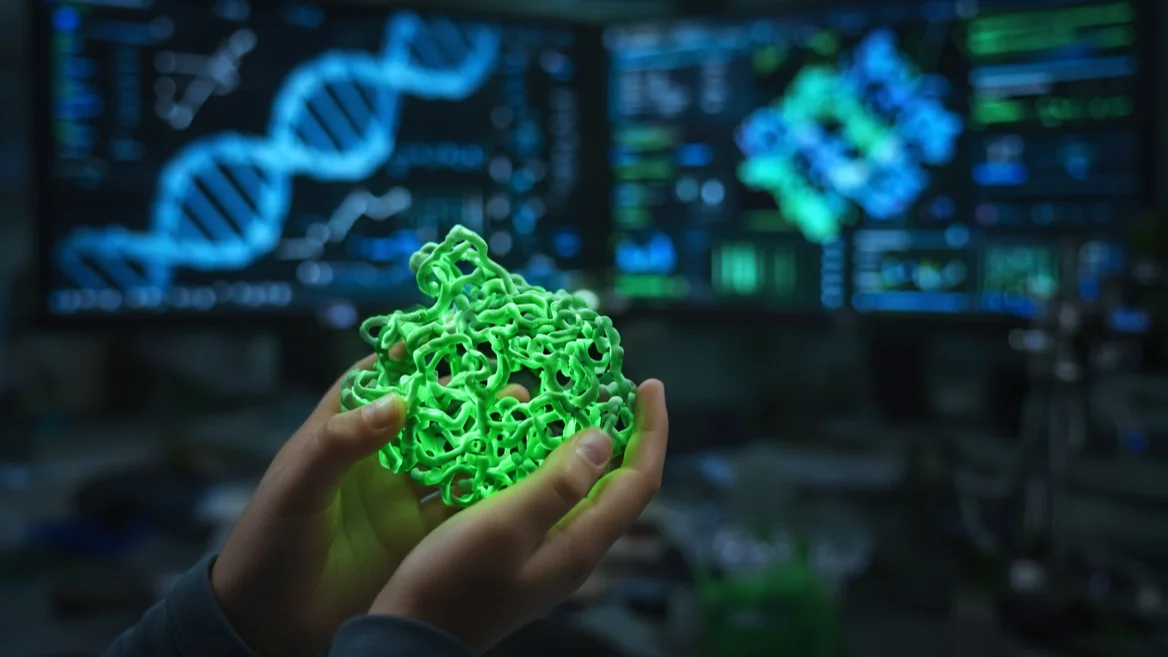
Inside our bodies, we have tiny, microscopic building blocks called proteins. They look like twisted, tangled pieces of yarn. For fifty years, the smartest scientists in the world tried to guess how these tiny blocks fold up. Finding the shape of just one block could take a scientist years of hard work!
Then, a super-computer program called AlphaFold tried to solve it. Guess what? It figured out the shapes of almost all the tiny blocks in just a few days! This is helping doctors create new medicines to make sick people feel better much faster.
Does this mean we won't need human scientists anymore? No way! AI is a fantastic helper, but it doesn't have a human heart, imagination, or the ability to dream up totally new ideas.
AI is not replacing scientists. It is simply the most powerful magnifying glass we have ever built, helping us look closer at the beautiful magic of our world!
But what if you had a magical robot friend who could look at every single brick in the pool in just one blink of an eye? That would be awesome!
Today, scientists in big laboratories have a new magical friend just like that. Its name is Artificial Intelligence, or AI for short. AI is not a metal robot walking around; it is a super-smart computer program. It doesn't sleep, it doesn't get tired, and it doesn't even take snack breaks! It is helping humans solve some of the biggest puzzles in the whole universe.
The Super-Fast Pattern Finder
Science is a lot like being a detective. You look for clues, you guess what happened, and you test your ideas. For a long time, human scientists had to look at all the clues by themselves.But today, we have computers that can look at millions of star pictures or dinosaur bones in a second. For example, when astronomers look at the night sky to find new planets, they don't look through telescopes all night anymore. Instead, they give the pictures to AI. The AI can spot a tiny, hidden planet that is so far away that a human eye would completely miss it. It is like having super-vision!
The Ice Cream and Swimming Trap
Even though AI is super fast, it is still not as smart as a real human child. Why? Because computers only look at numbers, they don't actually understand the world.Think about this funny puzzle: in the summertime, lots of people buy delicious ice cream. Also, in the summertime, lots of people go swimming in the pool.
If you show these numbers to a computer, it might say: "Aha! Eating ice cream makes people jump into the pool!"
We know that is silly! The real secret is just that the weather is hot. A computer cannot guess that by itself. It needs a human scientist to say, "Hey robot, you got it wrong! It's just summer!" That is why AI still needs humans to teach it how to think.
Cracking the Secret Protein Puzzle
Even if it makes silly mistakes sometimes, AI did something amazing recently that saved the world a lot of time.Inside our bodies, we have tiny, microscopic building blocks called proteins. They look like twisted, tangled pieces of yarn. For fifty years, the smartest scientists in the world tried to guess how these tiny blocks fold up. Finding the shape of just one block could take a scientist years of hard work!
Then, a super-computer program called AlphaFold tried to solve it. Guess what? It figured out the shapes of almost all the tiny blocks in just a few days! This is helping doctors create new medicines to make sick people feel better much faster.
| What Humans Do Best | What AI Robots Do Best |
|---|---|
| Flashes of Intuition: Having "Aha!" moments | Super Speed: Looking at millions of clues at once |
| True Understanding: Knowing why things happen | Never Tired: Working all night without sleeping |
| Creative Imagination: Thinking of brand-new ideas | Perfect Memory: Remembering every single detail |
The Future: Robo-Labs!
In some futuristic laboratories, AI is now working with real robotic arms. The computer thinks of an idea, the robotic arm mixes colorful liquids in glass tubes, and they check the results together. If the experiment doesn't work, the computer tries a new idea a second later!Does this mean we won't need human scientists anymore? No way! AI is a fantastic helper, but it doesn't have a human heart, imagination, or the ability to dream up totally new ideas.
AI is not replacing scientists. It is simply the most powerful magnifying glass we have ever built, helping us look closer at the beautiful magic of our world!