CosmosJul 15, 2026•3 min read
NASA's Telescope Just Spotted a Cosmic Body That Defies All Laws of Physics

Emre IpekyuzFounder & Science Writer
CosmosJul 15, 2026•3 min read
NASA's Telescope Just Spotted a Cosmic Body That Defies All Laws of Physics
Emre IpekyuzFounder & Science Writer
“
NASA just found an impossible planet that shouldn't exist.
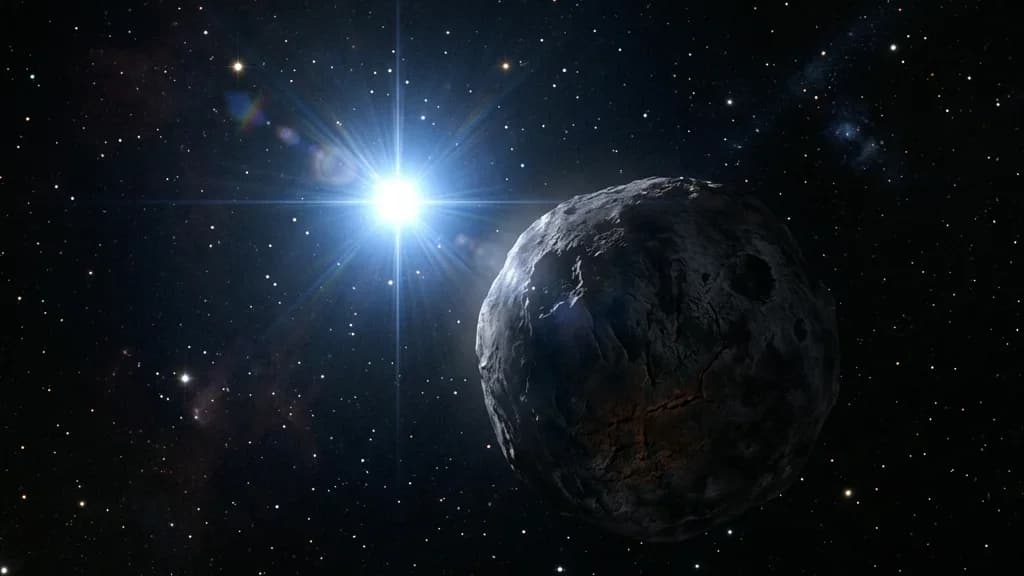
For decades, the standard rules of cosmic evolution were considered absolute: astronomers mapping the boundaries of the universe thought they had a solid grip on planetary formation and stellar deaths. But what happens when the universe decides to rewrite the textbooks we rely on? One such anomaly is a celestial body known as PSR J2322-2650b, orbiting deep within the harsh radiation field of a dead star.
Discovered deep within our galaxy, orbiting a millisecond pulsar that spins hundreds of times per second, this object is not a gas giant in the traditional sense. Scientists believe that this massive body is actually the stripped core of what was once a glowing companion star—a white dwarf.
After the host star went supernova and collapsed into a pulsar, the intense radiation blasted away the outer layers of this companion star without mercy. What remains is an ultra-dense core, extremely rich in carbon and oxygen, trapped in a crushing gravitational grip. Orbiting much closer to its host than Earth is to the Sun, the severe gravitational forces have physically reshaped this remnant into an elongated, lemon-like silhouette rather than a perfect sphere.
RELATED: How the James Webb Space Telescope is Rewriting Cosmic History NASA
The universe, it seems, constantly proves that even the most destructive forces can leave behind exceptionally resilient and magnificent structures. What do you think about the existence of these massive diamond worlds? Do you believe more "zombie planets" are hiding in the deep corners of our galaxy? Let us know your thoughts in the comments below!
Source: A Jupiter-mass planet orbiting the millisecond pulsar J2322-2650, 2017 arXiv Astrophysics
A Stellar Remnant the Size of Jupiter
Discovered deep within our galaxy, orbiting a millisecond pulsar that spins hundreds of times per second, this object is not a gas giant in the traditional sense. Scientists believe that this massive body is actually the stripped core of what was once a glowing companion star—a white dwarf.
After the host star went supernova and collapsed into a pulsar, the intense radiation blasted away the outer layers of this companion star without mercy. What remains is an ultra-dense core, extremely rich in carbon and oxygen, trapped in a crushing gravitational grip. Orbiting much closer to its host than Earth is to the Sun, the severe gravitational forces have physically reshaped this remnant into an elongated, lemon-like silhouette rather than a perfect sphere.
RELATED: How the James Webb Space Telescope is Rewriting Cosmic History NASA
Diamond Worlds Defying Deadly Radiation
The existence of this "impossible" object challenges our fundamental understanding of how matter behaves under extreme cosmic conditions. Far from being completely destroyed by the death of its host star, this remnant may be slowly transforming into the universe's largest precious stone.Rethinking the Definition of a Planet
Astronomers can no longer view planets strictly as collections of gas or rock. The reality that stripped stellar cores can mimic planetary masses opens an entirely new frontier for investigating populations of massive "zombie worlds" across the cosmos.Analyzing Ultra-Dense Carbon Structures
The carbon-heavy nature of these bodies supports theories that extreme pressure can crystallize matter into colossal diamond structures. Future observations will help us understand exactly how these ultra-compressed carbon formations manage to shield the remaining core from intense, star-destroying radiation.Decoding the Evolution of Neutron Star Systems
Mathematical models are actively recalculating how predatory pulsar systems, often referred to as "black widows," consume their companions. By updating these models, we can better predict which masses will be obliterated in the most violent corners of the universe, and which will survive in such bizarre configurations.The universe, it seems, constantly proves that even the most destructive forces can leave behind exceptionally resilient and magnificent structures. What do you think about the existence of these massive diamond worlds? Do you believe more "zombie planets" are hiding in the deep corners of our galaxy? Let us know your thoughts in the comments below!
Source: A Jupiter-mass planet orbiting the millisecond pulsar J2322-2650, 2017 arXiv Astrophysics