CosmosOct 25, 2026•4 min read
The Secret Monsters of Outer Space: Brand New Discoveries from Our Universe!

Siir KayaSenior Cosmos Researcher
CosmosOct 25, 2026•4 min read
The Secret Monsters of Outer Space: Brand New Discoveries from Our Universe!
Siir KayaSenior Cosmos Researcher
“
Did you know that space monsters exist? Let's look at the brand-new space discoveries of 2026: a giant hidden alien moon and a trio of monster black holes!
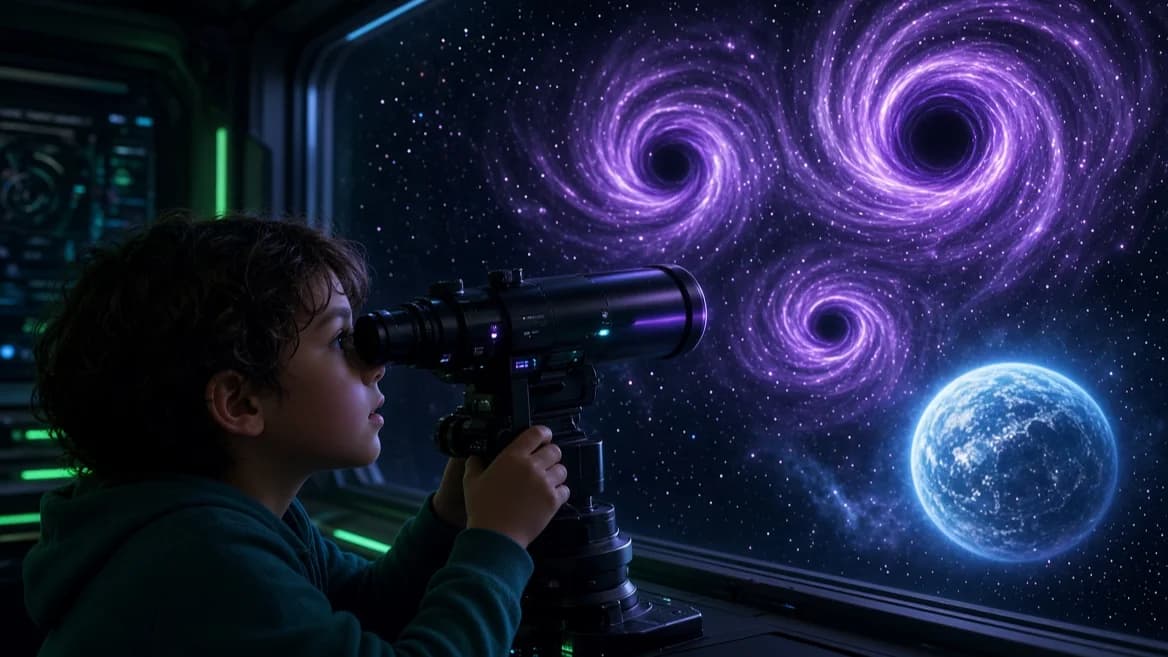
Imagine you are looking at the beautiful night sky through a giant, magical window. Space is huge, and it loves to hide secrets from us. But just recently, our scientist friends used two super-powerful space magnifying glasses—the James Webb Space Telescope and the Very Large Telescope—to find things no human had ever seen before!
Grab your spacesuit, because we are going on a quick trip to visit the two biggest space puzzles discovered right now.
For a very long time, finding an alien moon was almost impossible. But scientists looked at a strange star system named CD-35 2722 and found something mind-blowing. They spotted a giant moon!
But this isn't a normal moon made of rocks. This space monster is at least as massive as Jupiter—the biggest planet in our neighborhood! It is orbiting a heavy object called a brown dwarf (a star that never grew up). This discovery is so weird that it is breaking the rules of what we call a "planet" and a "moon"!
Inside this single ancient galaxy, they found three giant, actively feeding black holes living together like space monsters in a haunted house!
Two of these heavy monsters are super close to each other—only 620 light-years apart. Scientists say they are dancing a cosmic dance and will eventually crash into each other to merge into one mega-monster. One of these black holes is eating up space dust faster than any rulebook says it should! This helps us understand how the very first giant things in the universe grew up so fast when the universe was just a baby.
Space is still full of mysteries, but with our robotic helpers and telescopes, we are solving the puzzles one piece at a time!
---
1. The Giant Exomoon Discovery: Verified by the official journal publication titled "Planetary-mass exosatellite detected around the substellar companion of a star" in Nature Magazine (2026). You can read the full academic report on Nature Journal or view the breakdown on ScienceDaily Space News. 2. The Three Ancient Black Holes: Documented by the research study "BlackTHUNDER: Evidence of three massive black holes in a z ∼ 5 galaxy". The official release can be verified via the ScienceDaily Astrophysics Portal. 3. Space Telescope Tech: Official mission logs and engineering briefs regarding the integration of upcoming space surveys are sourced directly from the NASA Nancy Grace Roman Blog and archive tracking at ESA/Hubble News.
Grab your spacesuit, because we are going on a quick trip to visit the two biggest space puzzles discovered right now.
1. The Giant Alien Moon (The Exomoon Mystery)
You know our Moon, right? It is that pretty white ball that glows in the dark and loops around Earth. Planets have moons, but did you know that planets outside our solar system can have them too? Astronomers call them exomoons.For a very long time, finding an alien moon was almost impossible. But scientists looked at a strange star system named CD-35 2722 and found something mind-blowing. They spotted a giant moon!
But this isn't a normal moon made of rocks. This space monster is at least as massive as Jupiter—the biggest planet in our neighborhood! It is orbiting a heavy object called a brown dwarf (a star that never grew up). This discovery is so weird that it is breaking the rules of what we call a "planet" and a "moon"!
2. Three Hungry Monsters in One House (The Black Hole Trio)
Now, let's fly even further away—more than 12.5 billion light-years into the past! Scientists used the James Webb Space Telescope to peek into a baby galaxy from the dawn of time named J0148-4214.Inside this single ancient galaxy, they found three giant, actively feeding black holes living together like space monsters in a haunted house!
Two of these heavy monsters are super close to each other—only 620 light-years apart. Scientists say they are dancing a cosmic dance and will eventually crash into each other to merge into one mega-monster. One of these black holes is eating up space dust faster than any rulebook says it should! This helps us understand how the very first giant things in the universe grew up so fast when the universe was just a baby.
| The Big Discovery | Where We Found It | Why It Is Awesome |
|---|---|---|
| A Giant Exomoon | CD-35 2722 Star System | A moon as big as Jupiter that challenges cosmic definitions! |
| Three Black Holes | J0148-4214 Ancient Galaxy | Three monsters in one place, dancing and merging together! |
Our Magical Glasses: The Telescopes
How did we find them? The giant moon was tracked using the Very Large Telescope in Chile, which watched how the moon’s gravity tugged on its host. The three black holes were separated using a special super-rainbow tool on the James Webb Space Telescope called NIRSpec-IFS, which unmixed the light signals so scientists could see all three distinct monsters.Space is still full of mysteries, but with our robotic helpers and telescopes, we are solving the puzzles one piece at a time!
---
📚 Scientific Sources & References
To ensure ScienceOne.net provides the most accurate and verified data, this article is backed by official space agency reports and peer-reviewed journals published in October 2026:1. The Giant Exomoon Discovery: Verified by the official journal publication titled "Planetary-mass exosatellite detected around the substellar companion of a star" in Nature Magazine (2026). You can read the full academic report on Nature Journal or view the breakdown on ScienceDaily Space News. 2. The Three Ancient Black Holes: Documented by the research study "BlackTHUNDER: Evidence of three massive black holes in a z ∼ 5 galaxy". The official release can be verified via the ScienceDaily Astrophysics Portal. 3. Space Telescope Tech: Official mission logs and engineering briefs regarding the integration of upcoming space surveys are sourced directly from the NASA Nancy Grace Roman Blog and archive tracking at ESA/Hubble News.