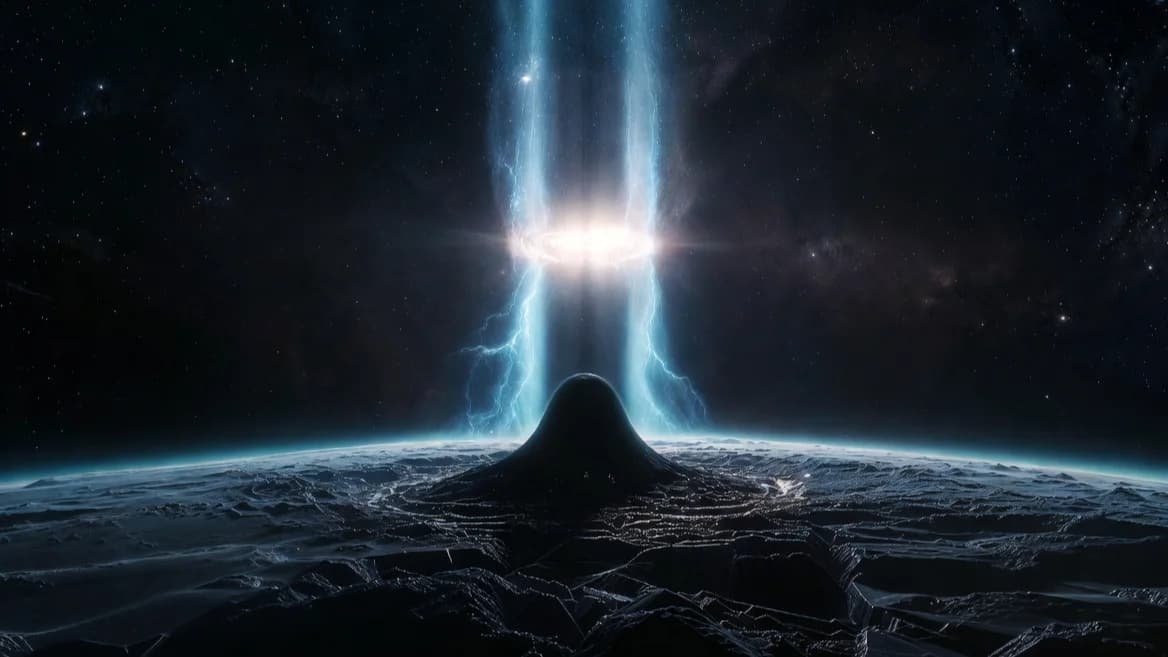
For decades, astronomers believed they understood how stars die and what becomes of their companions.
But a discovery buried in the data from the Parkes Radio Telescope in Australia forced scientists to rewrite a small but stunning chapter of that story.
The object in question is called
PSR J1719-1438b, and it orbits so close to a millisecond pulsar that it shouldn't, by most conventional models, still exist at all.
Discovered in 2011 by astrophysicist Matthew Bailes and his team, this strange world remains one of the most compelling examples of just how bizarre stellar remnants can be.
---
| Property | Value |
|---|
| Mass | ~1 Jupiter mass (minimum estimate) |
| Orbit Period | 2.2 hours |
| Pulsar Spin | Every 5.7 milliseconds |
| Distance from Earth | ~4,000 light-years |
| Location | Constellation Serpens |
| Discovery Year | 2011 |
| Detection Method | Pulsar timing |
---
PSR J1719-1438b orbits a millisecond pulsar — the ultra-dense, rapidly spinning remnant of a star that exploded as a supernova.
Far from being "dead," this pulsar is extraordinarily active:
it completes one full rotation every 5.7 milliseconds, firing beams of radio waves into space like a cosmic lighthouse.
Its planetary companion completes a full orbit in just
2.2 hours.
The system sits approximately
4,000 light-years from Earth, in the constellation Serpens.
The planet itself is not a gas giant in the traditional sense.
Researchers led by Bailes proposed that this object is the stripped-down core of what was once a normal companion star.
When the primary star in this binary system exploded and collapsed into a pulsar, its ferocious radiation and gravity tore away the outer layers of its companion.
What remained behind, scientists argue, is an ultra-compressed remnant made almost entirely of carbon and oxygen.
This remnant carries roughly the same mass as Jupiter — though it's worth noting that this figure is technically a
minimum mass estimate.
Because astronomers cannot directly observe the system's orbital inclination angle, the true mass could be somewhat higher; Jupiter's mass represents the lower bound of what the data allows.
Its density, however, is nowhere near that of a normal gas giant.
Degenerate matter behaves in strange ways under extreme pressure.
Greater mass in this kind of object tends to mean a smaller radius, not a larger one.
Despite holding roughly Jupiter's mass, PSR J1719-1438b is believed by scientists to be dramatically smaller.
According to the original 2011 research, the object's extreme density suggests it is closer in scale to Neptune than to a traditional gas giant.
This detail alone overturns the simple assumption that "same mass" means "same size."
Astronomers detected this hidden companion using an entirely different method than optical imaging — one worth understanding on its own.
How Astronomers Found It
Bailes and his team detected PSR J1719-1438b using precise timing measurements of the pulsar's radio pulses, gathered by the
Parkes Radio Telescope.
Tiny, regular variations in the pulsar's signal revealed the gravitational tug of an unseen companion.
This technique, known as pulsar timing, has become one of the most reliable ways to detect exotic objects hidden in extreme radiation environments where conventional telescopes cannot see.
---
The idea that this object could be an enormous diamond captured public imagination in 2011, and it remains one of the most evocative theories in modern astrophysics.
It is important to be clear, however, that this "diamond" label is a theoretical inference, not a confirmed observation.
No telescope has directly imaged crystallized carbon on this object's surface.
Why Scientists Suspect Crystallized Carbon
The reasoning is based on physics, not direct evidence.
Carbon-oxygen white dwarf cores, when subjected to the crushing pressures created by close orbits around a pulsar, are theoretically expected to crystallize.
Under such extreme compression, carbon can settle into a dense, ordered lattice structure similar to that of a diamond.
Researchers stress that this remains a working hypothesis supported by models of degenerate matter, rather than a settled fact.
As Bailes and colleagues noted in their 2011
Science paper, the object's composition and structure are consistent with a carbon-rich remnant that has undergone phase transitions under immense gravitational stress.
Rethinking What Counts as a "Planet"
This discovery complicates the definition of a planet.
If a stripped stellar core can end up with planetary mass and orbit a pulsar like a planet does, should it still be classified as one?
The carbon-rich, diamond-like nature of this particular remnant sits at the center of that debate, blurring the boundary between "dead star fragment" and "planet" in a way few other objects do.
---
More than a decade after Bailes and his team published their findings in 2011, PSR J1719-1438b remains an important case study in the evolution of extreme binary star systems.
It illustrates how a stellar companion can be transformed — rather than destroyed — by a supernova's aftermath.
No follow-up mission has directly imaged the object since its discovery, largely because the pulsar timing method used to detect it doesn't produce visual data.
But the underlying physics it revealed continues to shape how astronomers think about the boundary between stellar remnants and planets.
The universe, it turns out, can compress the remains of a former star into something that may resemble a jewel — even if we can't yet prove it sparkles.
What do you think about the possibility of diamond worlds hiding in our galaxy?
Do you believe more of these exotic planetary remnants are waiting to be found?
Let us know your thoughts in the comments below!
---
Source: Bailes, M., et al. (2011). "Transformation of a Star into a Planet in a Millisecond Pulsar Binary."
Science, 333(6050), 1717–1720.
arXiv:1108.5201