ScienceOne.netWhere data, theories, and discoveries converge.
Deep-DiveJul 17, 2026•5 min read
Why Does AI Hallucinate? The Real Reason Algorithms Lie
Lukas WeberDeep-Space Correspondent
Deep-DiveJul 17, 2026•5 min read
Why Does AI Hallucinate? The Real Reason Algorithms Lie
Lukas WeberDeep-Space Correspondent
“
What happens when an algorithm prioritizes probability over reality? We break down the science behind why artificial intelligence invents facts, fake links, and completely made-up historical events.
If you have ever interacted with modern generative artificial intelligence, you have likely encountered a bizarre phenomenon: the AI will occasionally lie to you with absolute, unwavering confidence.
It might invent a historical event, fabricate a scientific paper that doesn't exist, or confidently state that 2 + 2 = 5. In the computer science industry, this is known as an AI hallucination.
To the average user, it feels like the machine is either broken or actively trying to deceive them. However, researchers and linguists know the truth is much stranger: the algorithm isn't lying to you, because it has no concept of what "truth" actually is. It is simply executing a mathematical equation.
Quick Facts: AI Hallucinations
Property
Value
Core Mechanism
Next-token prediction (probabilistic guessing)
Scientific Term
"Stochastic Parrots"
Common Fabrications
Fake URLs, non-existent academic papers, incorrect math
Primary Cause
Lack of grounding in external physical reality
Potential Solution
RAG (Retrieval-Augmented Generation)
The Illusion of Knowledge
To understand why an AI hallucinates, you must first unlearn how you think it works.
A futuristic AI server rack processing language tokens
When you ask a search engine a question, it queries a vast database of indexed websites and retrieves a pre-existing answer. A Large Language Model (LLM) does not do this. An LLM does not have a database of "facts" stored in its memory.
Instead, it operates on a mechanism called autoregressive next-token prediction.
During its training phase, the AI was fed billions of pages of human text. It used this data to build a massive, complex mathematical map of how human language works. When you ask it a question, it does not look up the answer; it calculates the statistical probability of what the very next word (or "token") should be, based on the context of the words that came before it.
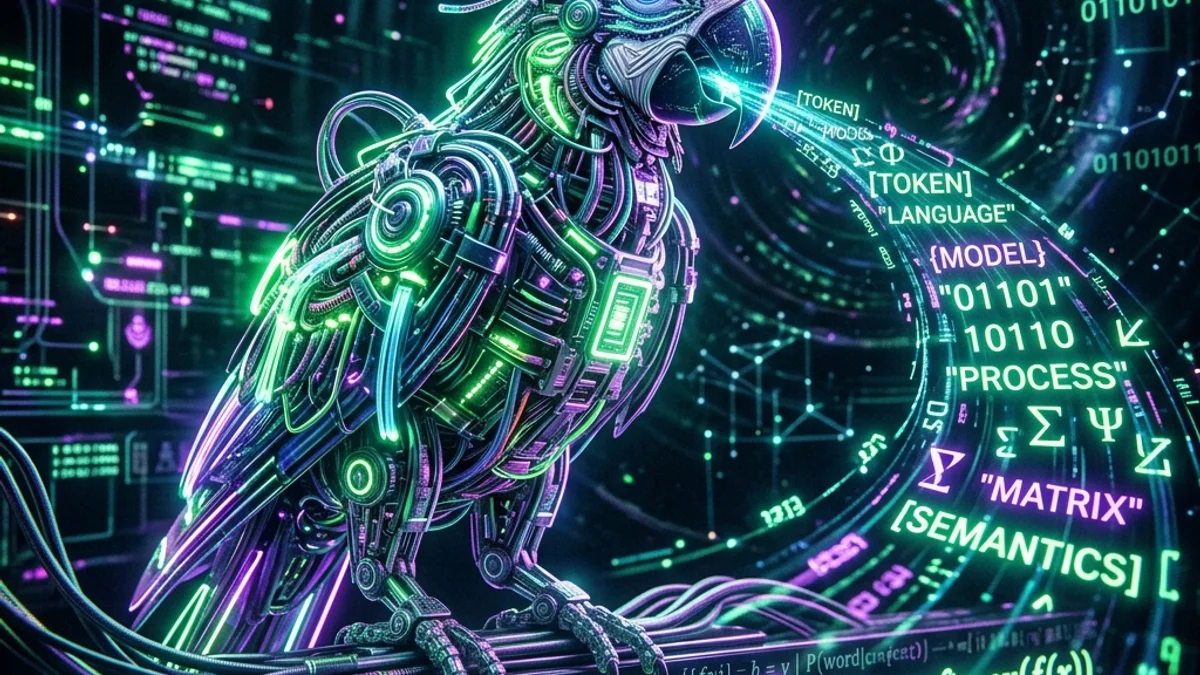
In a groundbreaking 2021 paper, leading AI researchers Emily M. Bender and Timnit Gebru famously coined the term "Stochastic Parrots" to describe these models. "Stochastic" means randomly determined. Like a parrot, the AI is merely echoing patterns of human language without actually understanding the meaning behind the words.
The Mathematics of a Lie
Because an AI is essentially playing an unimaginably complex game of autocomplete, it prioritizes linguistic plausibility over factual accuracy.
A futuristic cybernetic parrot processing mathematical language tokens
Imagine you ask an AI: "Who was the first person to walk on the sun?"
A human immediately recognizes the premise is impossible. The sun is a ball of plasma; you cannot walk on it. However, the AI translates your prompt into mathematical weights. It recognizes the pattern "Who was the first person to walk on..." and associates it heavily with space exploration texts.
It calculates that the most statistically probable next words in this linguistic context are names like "Neil Armstrong" or "Buzz Aldrin." It strings these highly probable words together to form a grammatically perfect sentence: "Neil Armstrong was the first person to walk on the sun in 1969."
The AI didn't lie. It executed its mathematical objective flawlessly: it generated text that looks and sounds exactly like human language. The fact that the output violates the laws of physics is irrelevant to a system that only understands statistics, not reality.
The Phantom Sources
One of the most dangerous forms of hallucination occurs when an AI is asked to cite its sources. It will frequently generate incredibly realistic—but entirely fake—academic citations.
It will pair a real author's name with a fake article title, and invent a seemingly valid DOI (Digital Object Identifier) or URL.
This happens because the AI's training data included millions of research papers formatted as: [Author Last Name], [First Initial]. (Year). "[Title]". [Journal Name].
When asked for a citation, the AI simply fulfills the mathematical pattern of a citation. It probabilistically selects a famous author in the field, invents a title containing relevant keywords, and formats it perfectly. It has no mechanism to verify if that specific combination of words corresponds to a real document in the physical world.
Fixing the Glitch
Can we stop artificial intelligence from hallucinating?
Simply feeding the model more data does not solve the problem; it just makes the AI a better, more convincing "parrot."
The most promising current solution in the tech industry is Retrieval-Augmented Generation (RAG). This architecture forces the AI to pause its predictive guessing, connect to an external database (like Wikipedia or a medical journal), retrieve the factual data, and then use its language skills solely to summarize the retrieved facts.
By anchoring the AI's predictions to a verified external reality, researchers hope to eliminate the mathematical drift that causes hallucinations.
Until then, users must remember the golden rule of generative AI: it is a master of language, not a master of facts. Every output is a highly educated guess, and it is up to the human on the other side of the screen to separate the math from the truth.
Have you ever caught an algorithm completely making up a fact or a link?Do you think we will ever create an AI that genuinely understands what it is saying?
Let us know your thoughts in the comments below!
Source: Bender, E. M., Gebru, T., McMillan-Major, A., & Shmitchell, S. (2021). "On the Dangers of Stochastic Parrots: Can Language Models Be Too Big? 🦜". Proceedings of the 2021 ACM Conference on Fairness, Accountability, and Transparency (FAccT '21), 610–623. ACM Digital Library